

Search for “billing orchestration solution” and almost every result explains payment orchestration instead. The two terms get used interchangeably, and they are not the same thing. One decides what to charge a customer and when. The other decides how that charge actually clears. Confusing them leads to buying the wrong tool, or assuming one product covers both jobs when it covers one.
The distinction matters because the money at stake sits in the gap between them. Involuntary churn, the revenue lost when a subscription lapses because a payment failed rather than because the customer chose to leave, accounts for 20 to 40 percent of total subscription churn, and payment failures drive up to 48 percent of it (FlexPay; Drips, 2024-25). Whether you fix that with a billing system, a payment layer, or both depends entirely on understanding which layer does what.
This guide draws the line. It defines billing orchestration, defines payment orchestration, shows how the two stack together, and explains where the responsibility for a failed payment actually lives.
What billing orchestration actually means
Billing orchestration is the layer that manages the subscription and invoicing lifecycle. It decides what a customer owes and when they owe it. That covers plan management, proration when someone upgrades mid-cycle, usage metering, invoice generation, tax calculation, revenue recognition, and the dunning sequence that chases an overdue account with emails and grace periods.
This is the territory of subscription billing platforms. Zuora targets large-scale operations with advanced revenue recognition and ERP integration. Chargebee serves SaaS and ecommerce companies with complex pricing and multi-currency invoicing. Recurly builds machine-learning retry timing into its dunning. Stripe Billing couples recurring invoicing tightly to the wider Stripe stack. Different products, same core job: model the commercial relationship and turn it into a bill.
What a billing platform does not do is decide how the resulting charge reaches a bank. It hands the charge to a payment processor and waits for a yes or no. If the answer is no, the billing system knows the payment failed, but it has limited control over why or what to try next. That control lives one layer down.
What payment orchestration handles
Payment orchestration is the layer that manages how a charge clears. Once a billing system says “charge this customer 49 dollars today,” the payment layer takes over: it selects a processor, tokenizes the card, applies any authentication, submits the transaction, and decides what to do when a processor declines or goes down.
A payment orchestration platform sits between your application and multiple payment service providers. You integrate once, and it handles the fan-out to individual processors. If you are new to the category, our explainer on what payment orchestration is covers the fundamentals. The core capabilities are routing each transaction to the processor most likely to approve it at the lowest cost, retrying a soft decline through an alternate processor, and failing over automatically when a primary provider has an outage.
None of that is billing logic. The payment layer does not know or care whether a charge is a one-time purchase or the fourteenth month of a subscription. It receives a charge request and gets it approved as reliably and cheaply as possible. That single-mindedness is the point.
Billing orchestration vs payment orchestration: the differences
The two split cleanly along one line: billing orchestration manages when and what a customer is charged, and payment orchestration manages how that charge is processed across providers (Recurly, 2025).
| Dimension | Billing orchestration | Payment orchestration |
|---|---|---|
| Core question | What to charge, and when | How the charge clears |
| Owns | Plans, proration, invoicing, tax, revenue recognition, dunning schedule | Routing, retries, tokenization, authentication, failover |
| Example products | Zuora, Chargebee, Recurly, Stripe Billing | Orchestra, Spreedly, Primer, Gr4vy |
| Data it holds | Customer, subscription, invoice, usage | Card token, transaction, processor response |
| Failure it prevents | Wrong or late invoice, voluntary churn | Failed transaction, processor outage, avoidable decline |
| PCI scope | Holds subscription and customer data | Holds the card-data boundary |
The reason the two get conflated is that some vendors bundle both. Several payment orchestration platforms now sell a “billing” module, and some billing platforms include basic retry logic. The bundling is real, but the two jobs are still distinct, and a bundle that is strong at one is often weak at the other.
How the two layers stack together
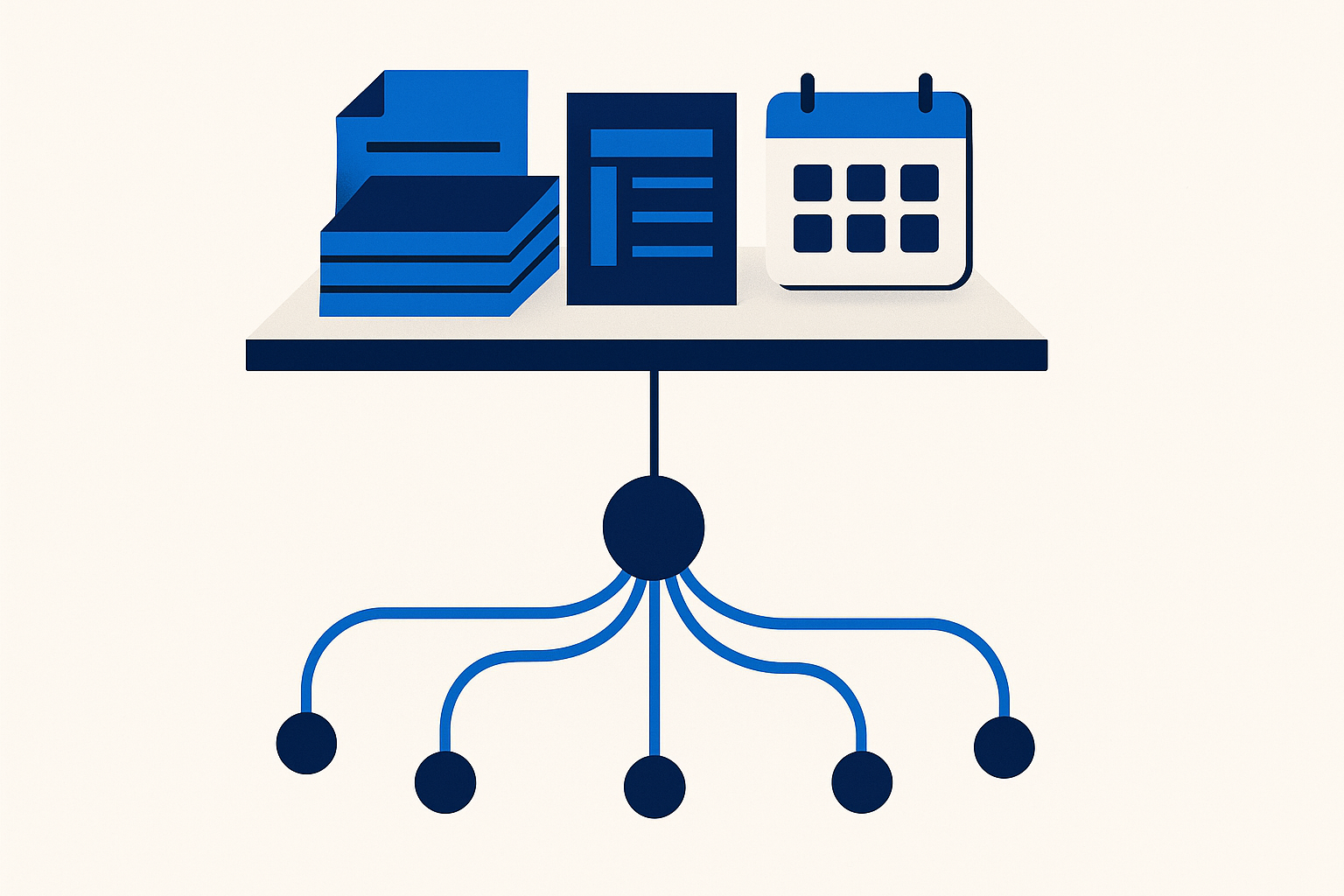
In a working subscription stack, the layers run in sequence rather than competing. The billing system sits on top and the payment layer sits underneath.
The flow for a monthly renewal runs top to bottom:
- The billing system reaches a renewal date, calculates what the customer owes including any usage or proration, generates the invoice, and emits a charge request.
- The payment orchestration layer receives the request, selects a processor based on card type, geography, and recent approval rates, then submits the transaction.
- The processor approves or declines.
- If the decline looks transient, the payment layer retries through a different processor before anyone is notified.
- The result, approved or failed, returns to the billing system, which marks the invoice paid or starts its dunning sequence.
Each layer does the part it is built for. The billing system never needs to know which of your processors handled the charge. The payment layer never needs to understand your pricing tiers. The interface between them is a charge request and a result, which is why a billing platform and a payment orchestration platform can be chosen and replaced independently.
Where the lines blur: retries, dunning, and failed subscription payments
The hardest part of the distinction is failed payments, because both layers respond to them and people assume that means they overlap. They do not. They handle different stages of the same failure.
When a subscription charge fails, the first response is a retry, and that belongs to the payment layer. A smart retry is not just trying the same processor again later. It is trying a different processor, or waiting for a network token to refresh, or routing around a processor that is declining a specific card range. This matters because the biggest single cause of recurring payment failure is expired or outdated card credentials, roughly 42 percent of failures (industry data, 2025), which network tokenization and account updater programs resolve at the payment layer. It also matters because retry placement beats retry volume: Visa and Mastercard cap merchants at around 15 retry attempts per card in 30 days (Slicker, 2025), so where you retry counts more than how often.
The second response is dunning, and that belongs to the billing layer. Dunning is the customer-facing sequence: the “your payment failed” email, the grace period, the eventual downgrade or cancellation. The billing system owns the schedule and the messaging because it owns the customer relationship.
The two responses compound. A smarter payment layer recovers more charges before they ever reach dunning, so the billing system triggers fewer dunning sequences in the first place. The numbers show why this is worth getting right. The median failed-payment recovery rate is only 47.6 percent, meaning the typical company recovers fewer than half of its failed payments (Recurly benchmark, 2023-24). Intelligent retries recover up to roughly 70 percent of failed transactions, while basic dunning alone struggles to break 30 percent (Slicker, 2025). Retry strategies informed by cross-processor data improve recovery by another 10 to 20 percentage points over single-processor logic (Slicker, 2025). A billing system with one processor behind it cannot reach those numbers no matter how good its dunning emails are, because it has nowhere else to send the retry.
Where Orchestra fits: the payment layer beneath your billing system
Orchestra is a payment orchestration platform, not a billing system. We do not handle invoicing, proration, tax, or revenue recognition, and we do not replace Zuora, Chargebee, or Stripe Billing. We are the payment-execution layer that sits underneath whichever billing platform you run.
For a subscription business, that means three concrete things:
- Recurring charges from your billing system get routed across 130+ providers to the processor most likely to approve each one.
- Failed renewals get retried through an alternate processor rather than dying on the first decline, using the same automatic failover that protects one-time payments.
- Expanding into a new market becomes a configuration change rather than a new processor integration, which is why subscription platforms that grow internationally benefit from a payment orchestration layer instead of wiring up regional acquirers one at a time.
The architecture argument for keeping this separate from your billing system is the same build-versus-buy calculation that applies to any payment infrastructure. Building cross-processor routing and retry logic into your billing setup means maintaining connections to every processor, keeping each integration current as APIs change, and dedicating engineering capacity to a problem that is not your core product. A dedicated payment layer absorbs that work through one integration. Your billing system keeps doing what it is good at, and your engineers keep building your product.
How to decide what you need
Start by naming the problem you actually have, because the two layers solve different ones.
If your invoices are wrong, your pricing is hard to model, or you cannot recognize revenue cleanly, that is a billing problem, and a payment layer will not touch it. You need a billing platform, or a better one.
If your invoices are correct but a meaningful share of renewals fail, if a single processor outage can stall your whole recurring book, or if every new market means another processor integration, that is a payment problem. You need payment orchestration underneath whatever billing system you already run.
Most subscription businesses past a certain scale need both, and the useful insight is that they are separate purchases. You can keep a billing platform you like and add a payment layer beneath it, or swap processors without touching your billing logic. Treating them as one product is what leads teams to over-buy a bundle that is mediocre at half the job, or to assume their billing platform’s single processor is as good as recovery gets. It is not. The gap between 47 percent and 70 percent recovery is the payment layer, and it sits below the billing system, not inside it.
Frequently asked questions
Is billing orchestration the same as payment orchestration?
No. Billing orchestration coordinates the invoicing, subscription, dunning, and revenue-recognition lifecycle. Payment orchestration routes the resulting charges across multiple processors for approval, cost, and uptime. They operate at different layers of the stack and are usually separate products.
Do I need both a billing system and payment orchestration?
If you run recurring or usage-based revenue, usually yes. The billing system decides what and when to charge. Payment orchestration decides how the charge gets processed and what happens when a processor declines or goes down. Past a certain scale, one without the other leaves money on the table.
Can payment orchestration handle recurring billing on its own?
It handles the payment execution for recurring charges, including routing, retries, network tokens, and failover. It does not handle the billing logic itself. Plans, proration, invoicing, and revenue recognition still live in a billing system.
What happens to a failed subscription payment, retry or dunning?
Both, at different stages. The payment layer retries first, ideally through an alternate processor, before the customer sees anything. If recovery fails, the result returns to the billing system, which runs its dunning sequence of emails and grace periods. A stronger payment layer means fewer charges ever reach dunning.
Does payment orchestration reduce involuntary churn?
Indirectly but materially. Involuntary churn is 20 to 40 percent of total subscription churn, and most of it is failed payments. Cross-processor retries and network tokens recover charges a single processor would lose, so fewer failed payments reach the dunning stage. The billing system still owns the dunning sequence itself.
Does Orchestra replace my billing platform like Stripe Billing, Chargebee, or Zuora?
No. Orchestra sits beneath the billing platform as the payment-execution layer. Your billing tool keeps managing subscriptions and invoices. Orchestra routes the charges those invoices generate across 130+ providers.
Where does dunning belong, billing or payments?
Dunning strategy, meaning the retry schedule, emails, and grace periods, belongs to the billing system because it owns the customer relationship. The payment layer informs it: smarter retries across processors reduce how often dunning is triggered in the first place.