
Payment gateway failover
Payment failover across multiple gateways
Send a primary gateway and an ordered list of backups with each payment. If one fails, Orchestra tries the next
Free to start • No credit card required
When a gateway goes down, payments keep moving
When your payment processor goes down or has network issues, every failed transaction is a lost sale. Put any of 130+ supported providers behind it as a backup, through the integration you already have.
Back up your processor with any of 130+ providers
How Orchestra failover works
Before Orchestra
Single gateway risk
- All transactions depend on one processor
- Processor downtime means lost sales
- Network issues cause payment failures
- No fallback when a payment fails
- Manual intervention required for issues
- Revenue loss during outages
With Orchestra
Failover on every payment
- An ordered fallback list on each payment
- Orchestra works down the list until one succeeds
- Backups use the integration you already have
- One standardized result, whichever provider ran it
- No manual switching during an outage
- Insufficient-funds retries timed by a partner model
Free to start • No credit card required
Your routing across every gateway
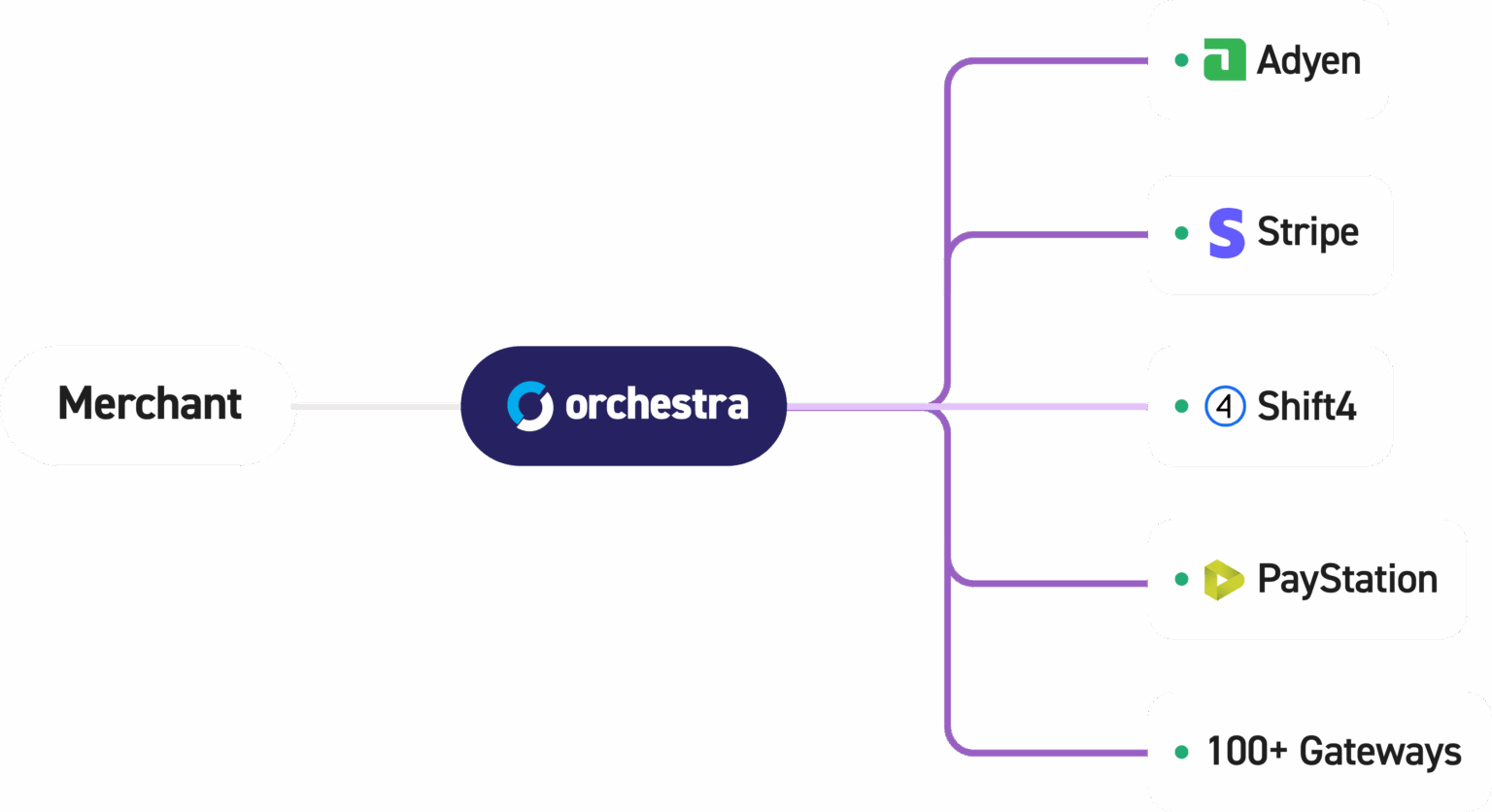
You choose the gateway, the merchant account and the backups for each transaction. If a payment fails, Orchestra retries it through the next processor in your list, so one provider’s problem does not have to stop checkout.
Complex multi-PSP management
- Separate integrations for each PSP (Stripe, Adyen, Worldpay…)
- Custom fallback logic when providers go down
- Re-architecting for each new market
- Weeks of development time per integration
With Orchestra
Single integration, global scale
- One integration connects to 130+ PSPs
- Built-in fallback through the providers you list
- Global-ready from day one, no re-architecture needed
- Add new PSPs without additional integration work
Failover in one request
Add the backups to the charge request. Orchestra tries them in order, without any action from the customer
// For each transaction, name the primary gateway account and an ordered list of backups
const response = await fetch('https://api.orchestrasolutions.com/PaymentGateway/charge', {
  method: 'POST',
  headers: {
    'Content-Type': 'application/json',
    'X-Api-Key': 'YOUR_API_KEY'
  },
  body: JSON.stringify({
    amount: 25.00,
    currency: 'USD',
    paymentGatewayAccountName: 'stripeProduction',
    fallbackUpgs: [
      { paymentGatewayAccountName: 'adyenBackup' },
      { paymentGatewayAccountName: 'worldpayTertiary' }
    ],
    card: {
      cardNumber: '@nQGywsQE9gbURtrXEjTZwtWqeMdK9nsO',
      cardHolderName: 'Jane Smith',
      expirationMonth: 12,
      expirationYear: 2027
    }
  })
});

const result = await response.json();
One integration. Two working parts.
Integration flexibility — your stack, your rules.
REST API
Drives everything after capture from your backend: charges on stored tokens, refunds, recurring billing
JavaScript SDK
Captures cards, wallets, and local payment methods in your checkout. Card data never touches your servers
See how the Library and API work together →
Free to start • No credit card required
Keep checkout running with failover
A provider outage no longer has to mean an outage at checkout
Failover included on every plan
Sequential fallback
On a failure, Orchestra works down your list until one provider succeeds or the list runs out
Your fallback order
Choose which backups to try, and in what order, on each transaction
Insufficient-funds recovery
For eligible insufficient-funds declines, a partner model picks the retry time most likely to succeed
Nothing extra for the customer
Fallback happens behind the scenes; the customer sees one result
Normalized responses
One response format and one set of decline reasons across providers
No extra integrations
Every backup runs through the integration you already have
The same security on every gateway
Cards are captured and stored by Orchestra, so switching gateways does not change how card data is handled
Free to start • No credit card required
PCI DSS Level 1
Certified card capture and storage
PSD2
3D Secure authentication, in line with SCA
ISO/IEC 27001:2022
Certified information security management
Portable vault
A card stored with Orchestra works with any connected provider